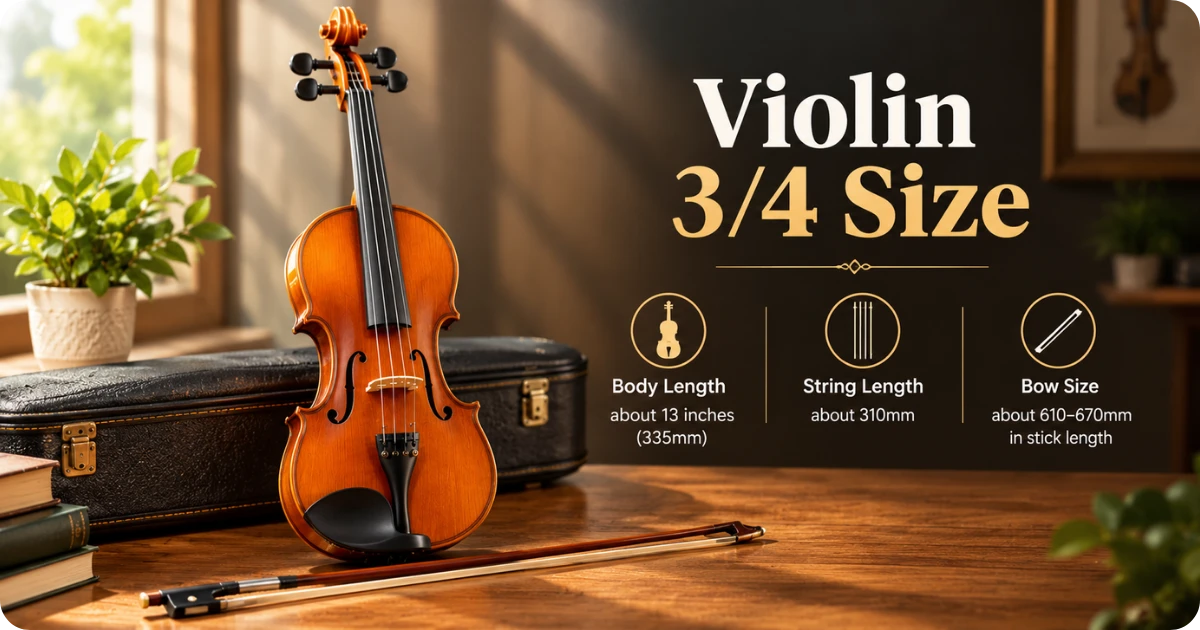
3/4 violin size: body length about 13 inches (335mm), string length about 310mm. Bow size for it: about 610–670mm in stick length.
Getting this size right matters more than most parents realize. A violin that’s too big strains the shoulder, wrist, and hand — and can slow down technique for months. The good news: sizing a violin correctly takes about five minutes and one tape measure.
What Is a 3/4 Size Violin?
3/4 Violin Size Explained
The fraction in “3/4 violin” is a naming convention, not a real measurement. A true 3/4 of a 4/4 violin’s 14-inch (356mm) body would be about 10.5 inches. In reality, a 3/4 violin’s body measures roughly 13 inches (335mm) — barely an inch shorter than full size.
Violin makers settled on these fraction labels generations ago, and the names stuck even though the math doesn’t quite work out. This mismatch trips up a lot of first-time buyers.
Who Plays a 3/4 Size Violin
Most 3/4 violin players are children between 7 and 11 years old. But age is a rough guide, not a rule — arm length is what actually determines fit.
Smaller-framed teens and petite adult women sometimes play 3/4 violins permanently, especially if a full-size instrument causes shoulder or wrist strain. Some professional players even choose smaller instruments by preference, not necessity.
Violin 3/4 Size Chart
Chart by Arm Length and Age
Arm Length
Approx. Age
Approx. Height
Violin Size
18″–20″
6–8
4’–4’5″
1/4
20″–21.5″
8–10
4’5″–4’9″
1/2
21.5″–23″
10–12
4’9″–5′
3/4
23″+
12+
5’+
4/4
Treat this chart as a starting point, not a final answer. Body proportions vary a lot between kids of the same age — this is exactly why arm length beats age or height as a sizing method.
How to Measure Arm Length for a 3/4 Violin
Here’s the standard method used across violin shops:
Have the player stand and extend their left arm straight out to the side, parallel to the floor.
Measure from the base of the neck (where the shoulder meets the collarbone) to the middle of the open palm.
Compare that number to the chart above.
This mimics the actual playing position, which is why it’s far more reliable than a height or age guess.
Quick Fit Tests You Can Do at Home
Two simple checks confirm whether a 3/4 violin fits correctly:
The scroll-cup test: with the violin in playing position and the left arm extended, the player should be able to comfortably curl their hand around the scroll (the curled top of the instrument).
The elbow-angle test: holding the violin in playing position, the elbow should bend to roughly a 90-degree angle. Too straight means the violin is too big; too tight means it’s too small.
If either test feels strained or awkward, it’s worth trying a different size before buying.
3/4 Violin vs Other Sizes Compared
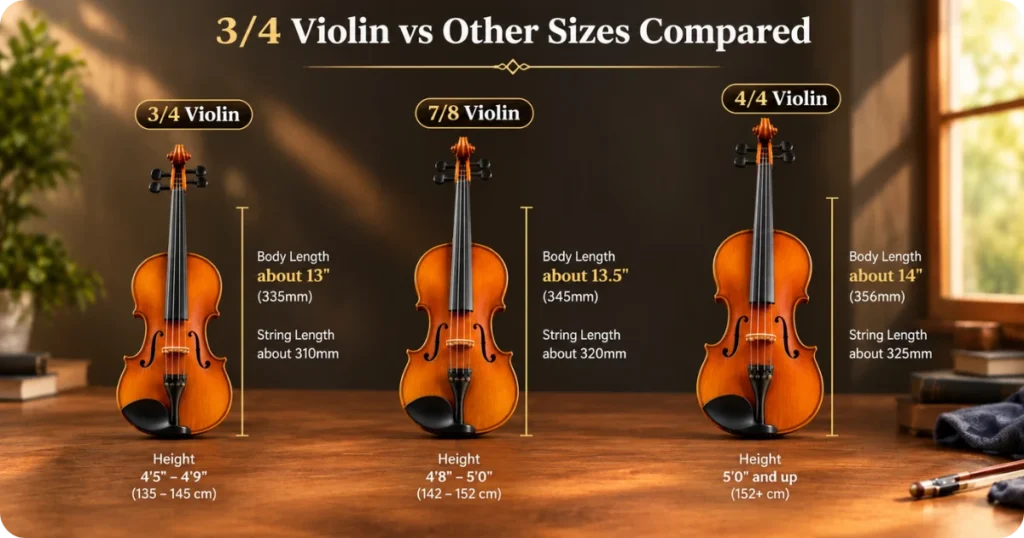
3-4-violin-vs-other-sizes-compared
3/4 vs 7/8 Violin Size
The 7/8 size sits between 3/4 and full size, and it’s the size most often confused with 3/4. A 7/8 violin has a body length of roughly 13.5 inches — about a half-inch bigger than a 3/4, and a half-inch smaller than a 4/4.
It’s a common “in-between” choice for growing preteens or smaller-framed adults who find a full 4/4 slightly too large. Not every violin shop stocks 7/8 sizes, since demand is smaller than for 3/4 or 4/4.
3/4 Violin vs 4/4 Violin
A 3/4 violin has a body length of about 13 inches (335mm) and a string length of around 310mm, while a full-size 4/4 violin measures about 14 inches (356mm) in body length with a string length of roughly 325mm.
The 3/4 is typically played by kids aged 7 to 11 and by petite adults, whereas the 4/4 suits most teens and adults. In sound, the 3/4 is slightly thinner and less resonant, while the 4/4 produces a fuller, richer tone.
3/4 vs 1/2 Violin Size
A 1/2 size violin measures about 12.25 inches (310mm) in body length — roughly two sizes smaller than 3/4. Kids typically move from 1/2 to 3/4 between ages 8 and 10, though again, this depends entirely on arm length.
If a player’s arm length falls right at the edge between two sizes, most teachers recommend sizing down rather than up — a slightly small violin is far easier to play correctly than one that’s too big.
Signs Your Child Has Outgrown a 3/4 Violin
Posture and Playing Signs It’s Time to Size Up
Watch for these warning signs that a 3/4 violin no longer fits:
The elbow locks nearly straight when reaching for higher positions on the fingerboard.
The player hunches the shoulder or tilts the head excessively to reach the chinrest.
Reaching the scroll requires stretching, not a comfortable curl of the hand.
The player complains of wrist or shoulder soreness after practice.
Any one of these signs is worth a re-measurement, even if the child hasn’t hit the “typical” age for sizing up.
How Long a 3/4 Violin Typically Lasts
Most players stay in a given fractional size for about two years before growing into the next one. Growth spurts vary widely, though, so it’s smart to re-measure arm length every six months during the elementary and middle-school years rather than assuming a fixed timeline.
Buying a 3/4 Violin: Rent, Buy, and What to Look For
Should You Rent or Buy a 3/4 Size Violin?
Because kids usually outgrow a 3/4 violin within two years, renting is often the smarter choice — especially for beginners. It avoids resale hassle and makes sizing up easy. Buying makes more sense once a student is committed long-term and a teacher confirms the size will last.
Matching Bow Size to a 3/4 Violin
Bow size should match violin size, not body size directly. A 3/4 violin typically pairs with a bow measuring roughly 610–670mm in total stick length.
Swapping to a new violin size usually means swapping the bow too — an easy detail to forget, since bows aren’t always sold as part of a size-labeled outfit.
What to Check Before Buying a 3/4 Violin
Before purchasing, confirm the following:
The instrument has been properly set up (bridge shape, string height, sound post placement) — not just shipped as-is.
The strings are sized correctly for a 3/4 instrument; using full-size strings on a smaller body increases the risk of breakage and hurts tone.
The seller offers a trade-in or upgrade credit toward the next size, since most players will need one within a couple of years.
A teacher has reviewed the fit in person, not just the measurements on paper.
FAQs About 3/4 Size Violins
What age is a 3/4 violin for?
Most players use a 3/4 violin between ages 7 and 11, but arm length — not age — is the real deciding factor.
Is a 3/4 violin full size?
No. A 3/4 violin is one size smaller than full size (4/4), with a body about one inch shorter.
What’s the difference between a 3/4 and 7/8 violin?
A 7/8 violin is roughly a half-inch bigger than a 3/4, sitting between 3/4 and full size. It suits players who find 4/4 slightly too large.
Can an adult play a 3/4 size violin?
Yes. Petite adults, especially those with shorter arm lengths, sometimes play 3/4 violins permanently and comfortably.
How do I know my violin size is correct?
Measure arm length from shoulder to palm with the arm extended, then check it against a sizing chart. The scroll-cup and elbow-angle tests confirm fit in the playing position.
Does violin size affect sound quality?
Yes. Smaller violins produce a thinner, less resonant tone than full-size instruments, due to their smaller body cavity — this is a physical limitation, not a manufacturing flaw.
Claire Davis is a content researcher and writer specializing in musical instruments, sizes, measurements, and comparison guides. She creates clear, practical content to help readers understand violin and other instrument sizes with confidence.