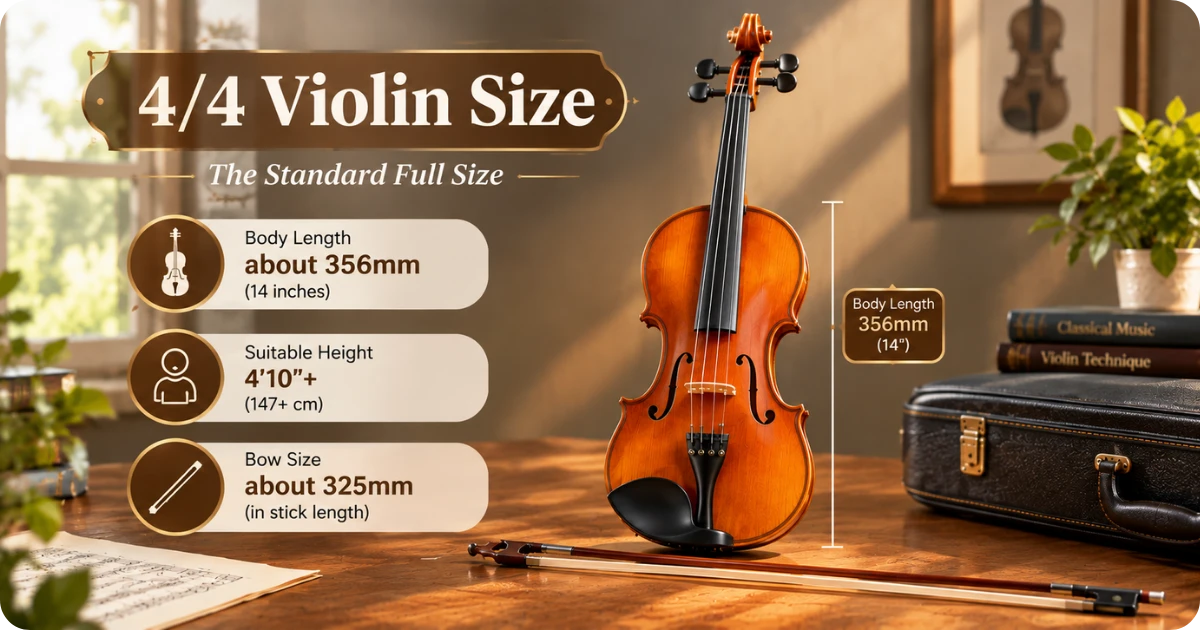
A 4/4 violin is the standard full-size violin, measuring about 23 inches (58–59 cm) from scroll to endpin. It’s the size most adults and older students need once their arms are long enough to reach it comfortably.
Choosing the wrong size can hurt your technique — and even your body. This guide breaks down exactly what a 4/4 violin size means, who needs one, and how to check your fit before you buy.
4/4 Full-Size Violin Chart
Measurement
4/4 Size Violin Range
Arm Length
23+ inches (58.5+ cm)
Typical Age
11 years–adult
Approximate Height
4’10″+ (147+ cm)
Body Length
~356 mm (14 inches)
Total Length
~23 inches (58–59 cm)
Bow Size
~740–750 mm
What Is a 4/4 Violin Size?
4/4 Full-Size Violin Measurements
A 4/4 full-size violin has a body length of roughly 14 inches (356 mm), measured from the top edge to the bottom edge of the instrument — not including the neck or scroll. The total length, scroll to endpin, comes out to about 23 inches (58.5–59 cm).
Here’s something most guides skip: that measurement isn’t perfectly fixed. Violins built on a Stradivari pattern and those built on a Guarneri pattern can differ by a few millimeters in body outline, even though both are labeled 4/4. That’s why two “full-size” violins from different makers can feel slightly different in your hands.
Who Needs a Full 4/4 Violin?
Arm Length and Height
As a general benchmark, players need an arm length of about 23 inches (58.5 cm), measured from the base of the neck to the middle of the palm, to comfortably handle a full-size violin. Height matters too: most players under 5 feet tall are usually more comfortable on a slightly smaller instrument, even as adults.
This is a detail competitors rarely spell out clearly: being an adult doesn’t automatically mean 4/4 is your size. Petite adults and players with shorter arms or smaller hands often play beautifully on a 7/8 or even a 3/4 violin for their entire lives. There’s no shame in it — comfort and technique matter far more than the label on the instrument.
Stand straight and extend your left arm fully out to the side, parallel to the floor, with no bend at the elbow or wrist. Using a flexible measuring tape, measure from the base of your neck to the middle of your open palm.
If that measurement lands near 23 inches (58.5 cm), a 4/4 violin is likely your correct size.
Signs a 4/4 Violin Is Too Big for You
If you already own a violin, hold it in playing position and extend your left arm straight. The scroll should rest right around your wrist. If the scroll sits deep in your palm, the violin may be too small; if your arm can’t reach it comfortably at all, it’s too big.
Watch your body, too. Shoulder tension, a hunched posture, or a 4th finger that can’t comfortably reach the fingerboard are all physical warning signs that a 4/4 violin doesn’t fit yet — no matter your age.
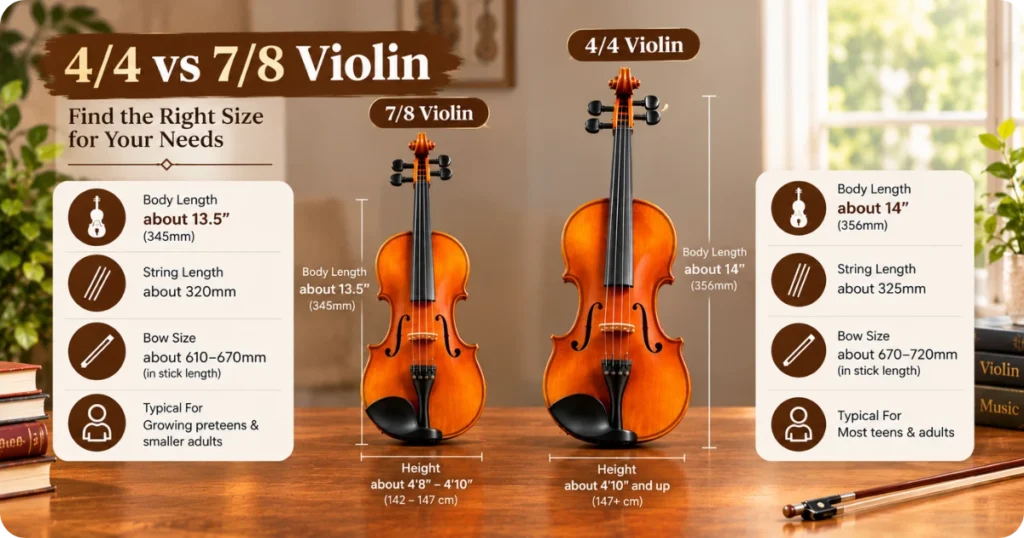
4/4 vs 7/8 Violin
4-4-violin-vs-7-8-violin-size
When a 7/8 Violin Makes More Sense Than a 4/4
A 7/8 violin is only slightly smaller than a 4/4, roughly 22 inches (57 cm) long, and it’s sometimes nicknamed the “lady’s violin” — though anyone can play one.
Consider 7/8 instead of 4/4 if you feel shoulder or wrist strain on a full-size instrument, if you’re a smaller-framed adult, or if you’re a growing student who’s outgrown 3/4 but isn’t quite ready for 4/4.
The tone difference between 7/8 and 4/4 is minor, so you lose very little sound quality by sizing down slightly.
In the US market, a beginner 4/4 violin outfit — instrument, bow, and case — typically starts in a modest, budget-friendly range, while intermediate outfits with better tonewood and setup cost noticeably more.
Higher price generally means better wood aging, string quality, and factory setup, all of which affect how easy the violin is to play and how good it sounds.
Adjusting Fit with a Shoulder Rest and Chin Rest
Even with the correct 4/4 size, small adjustments make a big difference. A properly fitted shoulder rest and chin rest can correct posture issues, reduce neck strain, and make a 4/4 violin feel more comfortable without changing the instrument’s actual size.
Many players who think they need a smaller violin just need better equipment setup. Before buying, it’s always worth having a teacher or experienced shop staff confirm your 4/4 violin size is correct. A quick playtest can catch fit problems a tape measure can’t.
A 4/4 violin is the full-size violin, measuring about 23 inches long from scroll to endpin, with a body length of roughly 14 inches (356 mm).
Is a 4/4 violin the same as a full-size violin?
Yes. 4/4 and full-size mean the same thing. It’s the largest standard violin size, used by most adults and students from about age 11 or 12 onward.
What age is a 4/4 violin for?
Most students move to a 4/4 violin around age 11 to 12, but this depends on arm length, not age alone. Some students reach full size earlier or later.
What arm length do I need for a 4/4 violin?
You’ll generally need an arm length of about 23 inches (58.5 cm), measured from the base of the neck to the middle of the palm, to comfortably play a 4/4 violin.
How do I know if I should play 7/8 instead of 4/4?
If a 4/4 violin causes shoulder or wrist tension, or if you have a smaller frame or shorter arms, a 7/8 violin may fit better while sounding nearly identical.
Can a smaller adult use a 3/4 violin instead of a 4/4?
Yes. Some petite adults or players with shorter arms are more comfortable long-term on a 3/4 violin, even though 4/4 is the standard adult size.
How long is a 4/4 violin in inches and centimeters?
A 4/4 violin measures about 23 inches, or 58 to 59 centimeters, from the scroll to the endpin.
Claire Davis is a content researcher and writer specializing in musical instruments, sizes, measurements, and comparison guides. She creates clear, practical content to help readers understand violin and other instrument sizes with confidence.