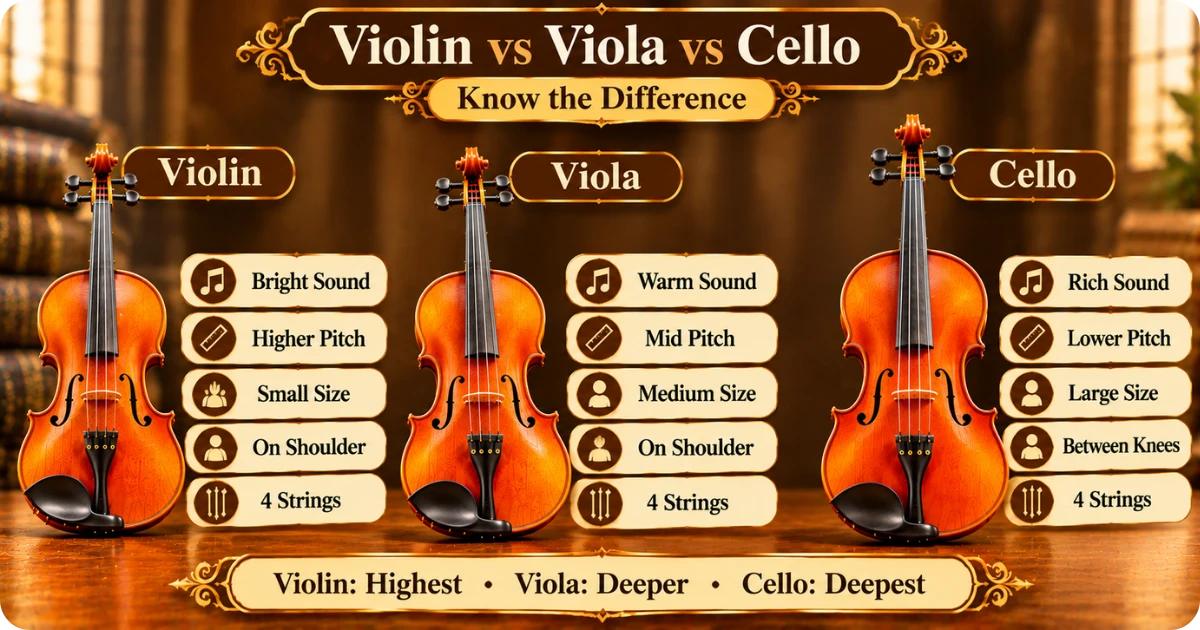
The violin, viola, and cello differ mainly in size, pitch, tuning, and playing position. The violin is the smallest and highest. The viola is a bit larger and deeper. The cello is the largest of the three and is played sitting down.
All three are bowed string instruments with four strings tuned in perfect fifths. This guide covers violin vs viola vs cello size, sound, playing style, cost, and which one fits you best.
Violin vs Viola vs Cello Differences at a Glance
Feature
Violin
Viola
Cello
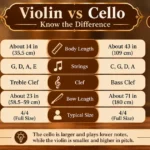
Body length (full size)
About 14 in (35.5 cm)
About 15.5–16.5 in (39–42 cm)
About 30 in (76 cm)
Strings (low to high)
G-D-A-E
C-G-D-A
C-G-D-A
Pitch
Highest
Middle
Lower, one octave below viola
Main clef
Treble
Alto
Bass
Position
Under the chin
Under the chin
Between the knees
Orchestra role
Melody
Inner harmony
Bass line and melody
Is a Viola Just a Bigger Violin?
Not quite. The viola looks like a violin, but it has a longer body, a thicker sound, and a lower C string. Its strings are thicker and its finger spacing is wider.
Is a Cello Just a Bigger Viola?
No. The cello has the same note names as the viola, but it sounds one octave lower. It also has an endpin, a larger bow hold, and a different playing posture.
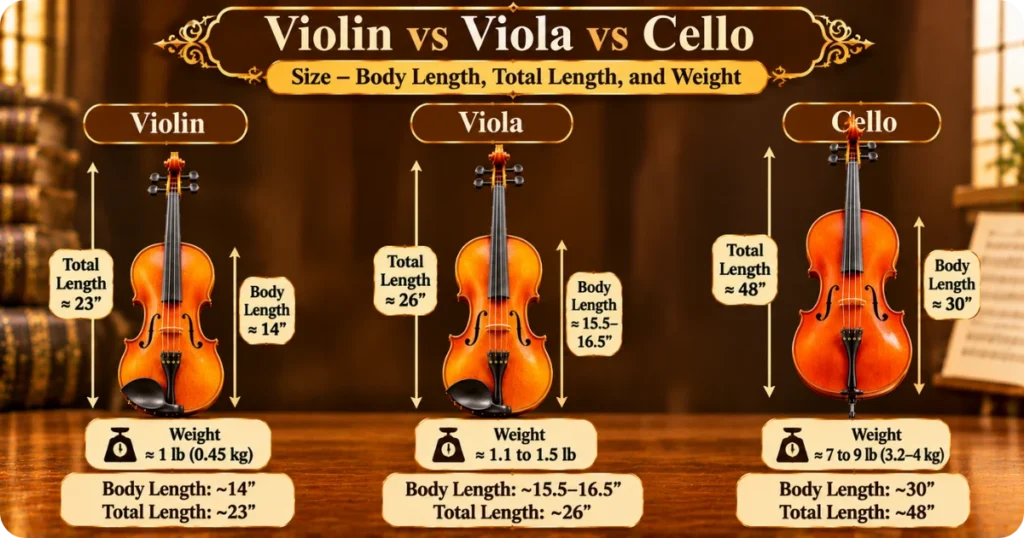
A full-size violin has a body length of about 14 in and a total length of about 23 in. It weighs around 1 lb (0.45 kg).
A full-size viola has a body length of 15.5 to 16.5 in and a total length of about 26 in. It weighs around 1.1 to 1.5 lb.
A full-size cello has a body length of about 30 in and a total length of about 48 in. It weighs around 7 to 9 lb (3.2–4 kg).
Fractional Sizes for Kids
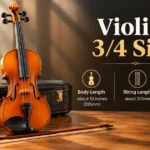
Young players use fractional sizes like 1/4, 1/2, and 3/4. Violins and cellos use fraction labels. Violas are usually sized by body length in inches, such as 12, 13, 14, or 15 in.
For a violin, measure the arm length from the neck to the middle of the palm. A full-size violin suits arms of about 23 in or more, which is roughly age 11 and up.
Cello sizing follows height and arm reach. Many teens and adults over about 5 ft 2 in fit a full-size (4/4) cello. A teacher or shop can confirm the right fit.
Portability and Practice Space
A violin or viola fits in a small case and travels easily. It works well in a small apartment or a school bus.
A cello needs a hard or padded case, a larger car, and floor space. Many US schools offer rental cellos or classroom storage to help.
The violin is tuned G3-D4-A4-E5. The viola is tuned C3-G3-D4-A4, which is a perfect fifth lower than the violin. The cello is tuned C2-G2-D3-A3, which is one octave below the viola.
The violin has an E string, but the viola and cello do not. They have a low C string instead.
Tone Color of Each Instrument
The violin sounds bright, clear, and sweet. The viola sounds warm, dark, and a little husky. The cello sounds rich, deep, and close to the human voice.
Clefs and Sheet Music
Violinists read the treble clef. Violists read the alto clef, which is a C clef, and sometimes the treble clef. Cellists read the bass clef, and also the tenor and treble clefs for high notes.
The alto clef is the biggest hurdle for violinists switching to viola.
Violin and viola rest on the left shoulder and under the chin. Many players use a shoulder rest or chin rest.
The cello rests on the floor on an endpin. The player sits on a chair and holds the cello between the knees. This posture gives the cello a more relaxed hold.
Bow Size and Bow Hold
A full-size violin bow is about 29.5 in (75 cm) and weighs about 60 g. A viola bow is about 29 in and weighs about 70 g. A cello bow is about 28.7 in (73 cm) and weighs about 80 g.
The viola and cello bows are heavier and have wider hair. This gives a fuller sound on thicker strings.
Role in the Orchestra and Ensembles
First violins usually play the melody. Second violins support with harmony. Violas fill the inner voice. Cellos play the bass line and often lead lyrical solos.
A typical full symphony orchestra has about 30 violins, 10 to 12 violas, and 8 to 10 cellos.
None is better. The best fit depends on age, body size, goals, and budget.
Which Is Easiest for Beginners?
The violin has the most teachers, books, and youth programs in the USA. But its small finger spacing makes intonation tricky.
The cello has wider spacing and an easier hold, but it needs more arm strength and space. The viola needs a stretch like a larger violin and has fewer learning materials.
Cost to Buy or Rent in the USA
A student violin outfit costs about $150 to $600. A student viola costs about $300 to $800. A student cello costs about $500 to $1,500.
Monthly rentals often run about $15 to $40 for violins and $30 to $60 for cellos. The price includes a bow and case in most outfit rentals. Always budget for rosin, strings, and repairs.
Best Choice by Age, Goal, and Music Style
Choose the violin for fiddle, folk, pop, and solo melody. Choose the viola if you like inner harmony, chamber music, and orchestra demand, since violists are often in short supply. Choose the cello for a deep, singing tone and solo or band bass lines.
What is the main difference between violin, viola, and cello?
The main difference is size and pitch. The violin is smallest and highest. The viola is slightly larger and lower. The cello is the largest and plays the bass range.
Is a viola bigger than a violin?
Yes. A full-size viola has a body length of 15.5 to 16.5 in. A full-size violin has a body length of about 14 in.
Which is harder to learn: violin, viola, or cello?
All three take regular practice. The violin has the smallest finger spacing, so intonation is harder. The viola needs a bigger stretch. The cello needs more arm strength but has a stable posture.
Which is lower, the viola or the cello?
The cello is lower. It sounds one octave below the viola, even though both use C-G-D-A tuning.
Can a violinist switch to viola?
Yes. The fingering pattern is the same. A violinist must adjust to the larger size, wider spacing, and alto clef.
Which string instrument is best for beginners?
The violin is the most common choice for young beginners, with the most lesson options. Adults and taller students may also enjoy the cello or viola. A teacher can help match the instrument to your body size.
Claire Davis is a content researcher and writer specializing in musical instruments, sizes, measurements, and comparison guides. She creates clear, practical content to help readers understand violin and other instrument sizes with confidence.