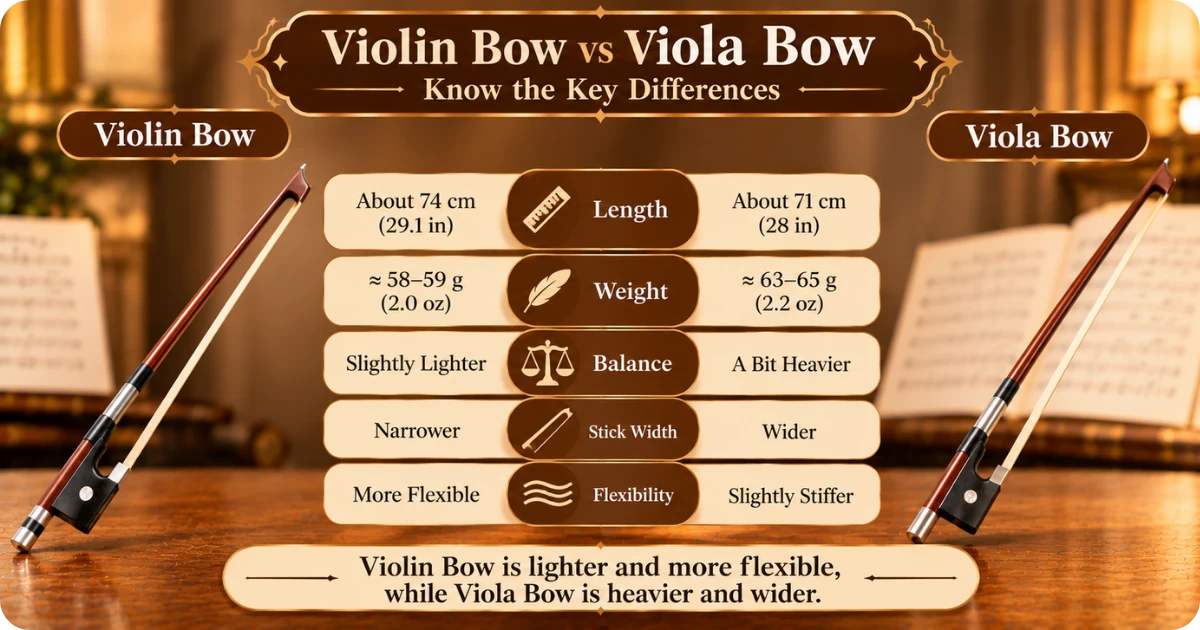
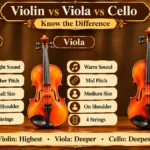
A violin bow is lighter, at about 60 grams, and has a squared frog. A viola bow is heavier, at about 70 grams, and has a rounded frog. Both full-size bows are about 29 inches long.
This guide is for US students, parents and teachers. It covers bow size, weight, design, swapping bows, materials and price. Each part is short and simple.
Violin Bow vs Viola Bow Design
Frog Shape and Stick Thickness
The frog is the block at the bottom of the bow. It is where you hold it. This is the easiest way to spot the difference.
A violin bow frog has a sharp back, near 90 degrees. A viola bow frog has a rounded back. It is often wider too. That shape gives a steady grip on a heavier bow.
The stick also differs. A viola stick is a bit thicker. It adds strength and control. A violin stick is thinner, which helps with speed.
Hair Width and Balance Point
A viola bow often carries a slightly wider ribbon of horsehair. This gives more contact with the thick strings. The result is a fuller, warmer sound.
Balance point matters as much as weight. For a violin or viola bow, it sits about 230 to 260 mm from the button. This is a guide, not a strict rule.
A well-balanced bow feels light, even when it is heavy. A poorly balanced bow feels clumsy, even when it is light. Folk players often like a slightly tip-heavy bow.
A full-size 4/4 violin bow is about 29 inches (74 to 75 cm) long. A full-size viola bow is about the same. Small differences can show up between bow makers.
So length is not the best way to tell them apart. Weight and frog shape are better clues.
Violin Bow vs Viola Bow Weight
Feature
Violin Bow
Viola Bow
Weight
54 to 65 g (average 60 g)
65 to 75 g (average 70 g)
Frog
Squared, about 90 degrees
Rounded, often wider
Stick
Thinner
Slightly thicker
Tone goal
Bright and clear
Warm and rich
A viola bow is about 10 grams heavier on average. That sounds tiny. In the hand, it feels very different.
A viola bow weighs more than a violin bow. The viola has thicker, lower strings (C, G, D and A). They need more bow pressure to speak. The extra weight gives that pressure with less effort.
Young players use fractional bows. Sizes run from 1/32 to 4/4. The right size depends on arm length, not only age.
To measure, turn the head to the left. Stretch the left arm straight out. Measure from the neck to the middle of the palm. This is called distance “A”.
Less than 15 inches: 1/32
15 to 15¾ inches: 1/16
15¾ to 16½ inches: 1/10
16½ to 18 inches: 1/8
18 to 20 inches: 1/4
20 to 21½ inches: 1/2
21½ to 23 inches: 3/4
23 inches or more: 4/4
Small violas have small bow sizes too. A full-size viola bow is often too heavy for a child. So kids on a fractional viola often use a violin bow. A teacher can confirm the fit.
Can You Use a Violin Bow on a Viola?
Yes, in a pinch. It is not ideal for a full-size viola.
Using a Violin Bow on a Viola
A violin bow is lighter. On a viola, it may give a thin, weak tone. The C string suffers most. You may also feel you are running out of bow.
It still makes sense for small kids on small violas. It also works for a quick emergency swap.
Using a Viola Bow on a Violin
Yes, you can use a viola bow on a violin. But it often feels heavy and slow.
Fast skills like spiccato and sautillé get harder. Your arm may tire sooner. The tone can turn darker and lose its sparkle.
Some players mix bows on purpose. They may want a warmer sound in slow music. Others switch between both instruments and carry only one bow. Try this only with a teacher’s advice.
Claire Davis is a content researcher and writer specializing in musical instruments, sizes, measurements, and comparison guides. She creates clear, practical content to help readers understand violin and other instrument sizes with confidence.