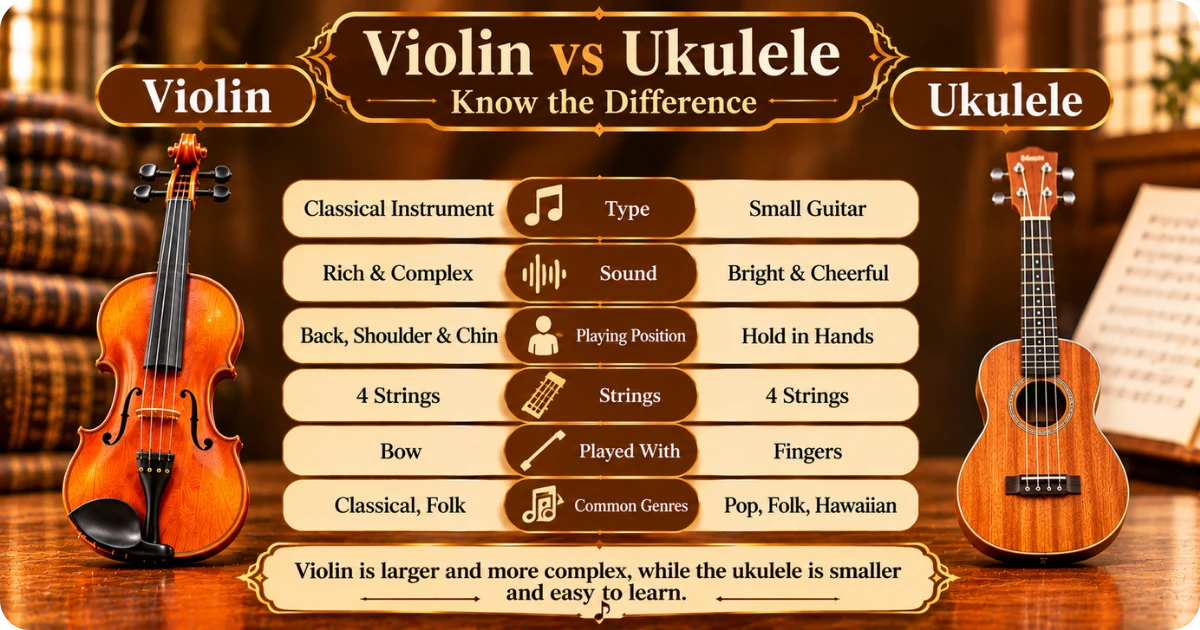
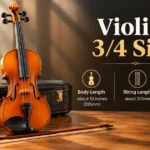
A full-size 4/4 violin is about 23 inches (59 cm) long. That is the same as a concert ukulele, longer than a soprano ukulele, and shorter than a tenor or baritone ukulele.
Both are four-string instruments, but their sizing systems work in different ways. This guide shows each size chart, the length in inches, and which one fits beginners and kids.
Violin vs Ukulele Size
violin-vs-ukulele-size
Is a Violin Bigger Than a Ukulele?
It depends on the ukulele size. Here is the total length of each:
Instrument
Length (inches)
Length (cm)
Length (mm)
Full-size violin (4/4)
About 23 in
About 59 cm
About 590 mm
Soprano ukulele
About 21 in
About 53 cm
About 530 mm
Concert ukulele
About 23 in
About 58 cm
About 580 mm
Tenor ukulele
About 26 in
About 66 cm
About 660 mm
Baritone ukulele
About 30 in
About 76 cm
About 760 mm
So a violin size at 4/4 sits right in the middle of the ukulele size range.
Violin vs Ukulele Length and Scale Length
Scale length is the vibrating string length, from the nut to the bridge. It tells you how a fingerboard feels under your hand.
A full-size violin has a scale length of about 13 inches (33 cm). A soprano ukulele is almost the same at 13 inches. A concert ukulele is about 15 inches, and a tenor is about 17 inches.
The shapes differ. A violin has a thin, arched body with a 14 inch length. A ukulele has a deeper body and a flat or slightly curved back.
Violin vs Ukulele Weight
Both instruments are lightweight. A full-size violin weighs about 1 pound (450 g). The bow adds about 2 ounces (60 g).
Most wooden ukuleles also weigh about 1 pound. A soprano is a little lighter, while a tenor or baritone is a little heavier.
A violin feels heavier in play. You hold it under the chin, so the chinrest and shoulder rest add weight. A ukulele rests against your chest or hangs from a strap.
A violin comes in fractional sizes. The right size depends on arm length, not only age. A ukulele has no such system.
Violin Size
Age
Arm Length (inches)
Arm Length (cm)
1/16
3 to 4
Under 14 in
Under 35 cm
1/10
4 to 5
14 to 14.5 in
35 to 37 cm
1/8
4 to 6
14 to 16 in
35 to 40 cm
1/4
5 to 7
16 to 17 in
40 to 44 cm
1/2
6 to 9
17 to 18.5 in
44 to 47 cm
3/4
9 to 11
18.5 to 20.5 in
47 to 52 cm
4/4 (full size)
11 and up
Over 20.5 in
Over 52 cm
Charts vary a little by maker. A teacher can confirm the fit.
How to Measure Arm Length for a Violin
This takes one minute:
Stand straight with the left arm held out to the side.
Keep the arm at shoulder height.
Measure from the base of the neck to the center of the palm.
Match the number to the size chart.
A violin that is too big forces the arm to stretch. This leads to poor intonation and tense posture. If the number sits between two sizes, choose the smaller one.
A child can start a violin as early as age 3 with a 1/16 size. The instrument shrinks to fit the child. But the child must move up a size every one to two years.
A ukulele does not scale this way. A soprano ukulele works well for kids ages 5 to 10. The frets guide the fingers, so it is easier to find notes. A violin has no frets, so players learn pitch by ear and muscle memory.
A soprano and a violin share a 13 inch scale length. Yet the violin is harder. On a violin, the spacing between notes gets tighter higher up the neck. There are no frets to mark it.
Portability, Case Size and Travel
Both instruments are portable. A ukulele gig bag is often smaller than a violin case. Most violin cases are about 30 inches long.
A violin also needs extra gear. This includes a bow (about 29 inches long), rosin, a shoulder rest, and a chinrest. A ukulele needs only a tuner and an optional strap.
A beginner ukulele costs about $30 to $100. A beginner violin costs about $100 to $300.
How Do the Strings on a Violin Compare to a Ukulele?
Both have four strings. A violin is tuned G-D-A-E in fifths. A ukulele is tuned G-C-E-A with a high G. Violin strings are steel or gut, while ukulele strings are nylon or fluorocarbon.
Can You Play Chords on a Violin Like a Ukulele?
You can, but it is rare. A violin plays melodies one note at a time. A ukulele is a chord instrument. It is strummed or plucked to play songs.
What Is the Price Range for a Beginner Violin vs Ukulele?
A beginner ukulele costs about $30 to $100. A beginner violin costs about $100 to $300. A violin also needs a bow and rosin, so the full cost is higher.
Is a Violin or Ukulele Easier for Beginners?
A ukulele is easier for most beginners. It has frets and simple chord shapes. A violin has no frets and needs bow control. It takes longer to sound clean.
Claire Davis is a content researcher and writer specializing in musical instruments, sizes, measurements, and comparison guides. She creates clear, practical content to help readers understand violin and other instrument sizes with confidence.