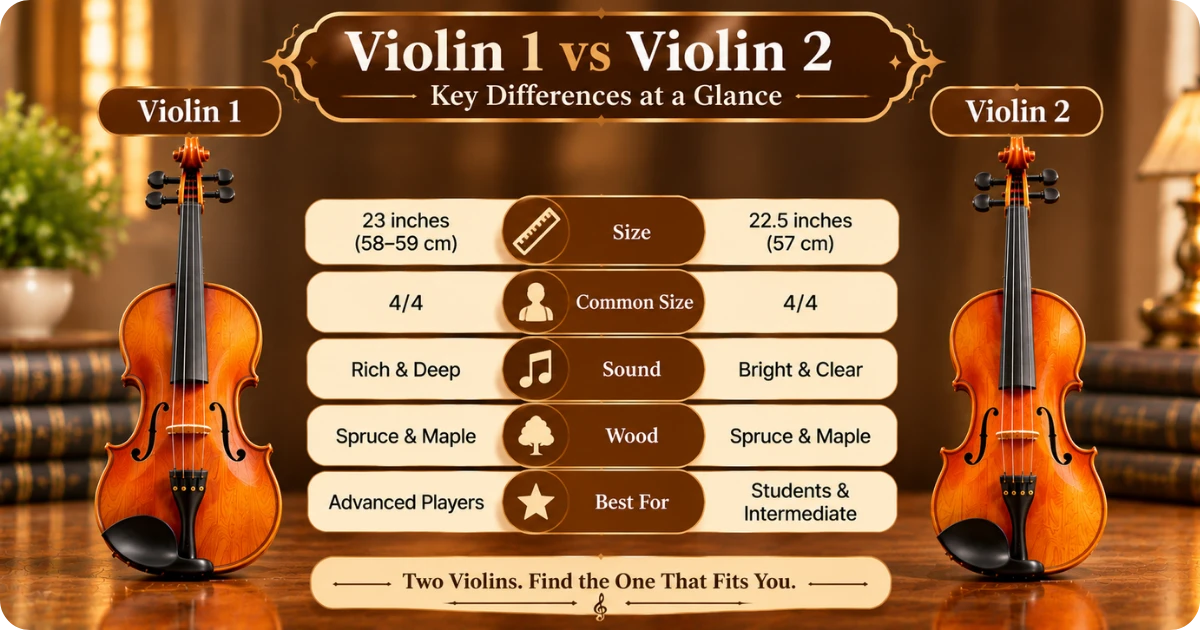
Violin 1 plays the main melody and the highest notes in the string section. Violin 2 plays harmony, rhythm and inner voices that support that melody.
Both parts use the same instrument. The difference is the role, not the size, skill or rank.
Violin 1 vs Violin 2 Roles
The two sections split the work of the violin family in an orchestra. Each section has its own job.
What Does the First Violin Play?
The first violins carry the melody most of the time. They often play in the high register, high up the E string.
Their parts are fast and exposed. The concertmaster leads the section and plays the violin solos.
What Does the Second Violin Play?
The second violins play harmony, inner voices and counter-melodies. They also keep the rhythm steady, often with syncopation.
Sometimes they step out and play the melody. At other times they double the first violins in unison.
In many classical symphonies, the seconds play the tune an octave lower. They must play it with full tone and feeling.
Is Violin 2 Harder Than Violin 1?
No. Both parts need equal skill. Players in both sections often audition with the same music.
Violin 1 has the speed and the high positions. Violin 2 has fast rhythms on the lower strings and tricky harmony lines.
In a string quartet, the second violin is the glue. It fills harmony, keeps time and shares the melody. Late quartets by Beethoven and Brahms test this part hard.
More Posts: Rosin vs Resin Violin
Violin 1 vs Violin 2 Size
Many readers ask if the two parts need different instruments. They do not.
Are First and Second Violins the Same Size?
Yes. Both sections use the same full-size 4/4 violin. Both use four strings, tuned G-D-A-E.
A first violinist can sit in the second section with no change of instrument. The part changes. The violin does not.
Full-Size 4/4 Violin Measurements
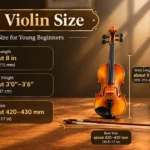
A 4/4 violin has a body length of about 14 inches (35.6 cm). Its total length is about 23 inches (59 cm).
A player needs an arm length of about 23 inches for a good fit. Measure from the base of the neck to the middle of the palm, with the arm straight.
Most players switch to full size around age 11. Most adults play full size.
Can Players Use a 7/8 or 3/4 Violin?
Yes, in either section. A 7/8 violin has a body of about 13.5 inches. It suits adults with small hands or short arms.
A 3/4 size fits players with an arm length near 22 inches. Section choice never depends on size. It depends on the part.
More Posts: Violin vs Ukulele
Violin 1 vs Violin 2 Seating
Seating shapes the sound balance of the orchestra. It also shows how the sections work together.
Where Do Violin 1 and Violin 2 Sit?
In the standard layout, the first violins sit on the conductor’s left. That is the audience’s left, at the front.
The second violins sit next to them, closer to the center. In a split layout (also called antiphonal seating), the seconds sit on the conductor’s right, across from the firsts.
A large symphony orchestra often has about 16 first violins and 14 second violins. The first violin section is usually the larger one.
Concertmaster and Principal Second
The concertmaster sits at the front of the first violins. This player leads the entire orchestra and tunes it before the concert.
The principal second violin leads the second section. This is a titled chair. It is paid above regular section players.
In a professional orchestra, section players in both sections are equal in pay and rank.
Do Players Rotate Between Sections?
Yes, in many orchestras. Some groups rotate seating between the first and second violins. Titled players usually stay in place.
Many strong players enjoy both roles. Moving between them builds listening skills, rhythm and high-position control.
More Posts: Violin Bow vs Cello Bow
Violin 1 vs Violin 2 Myths
Some old ideas still hurt young players. Facts clear them up.
Is Second Violin Easier or Lower?
No. The idea that second violin is “second best” is a myth. It often starts in school and youth orchestras, where seats are ranked by ability.
In a professional orchestra, every player earns their chair by audition. Second violin is a different job, not a lower one. The phrase “second fiddle” adds to this wrong idea.
Who Suits Each Part Best?
Violin 1 suits players who are comfortable in high positions and enjoy being exposed with the melody.
Violin 2 suits players with strong rhythm, sharp listening skills and a love for harmony. The role is like the alto in a choir. It adds depth to the whole sound.
More Posts: Violin vs Piano
FAQ’s About Violin 1 vs Violin 2
Is violin 2 harder than violin 1?
No. Both parts are equally hard in different ways. Violin 1 has speed and high notes. Violin 2 has tricky rhythms and inner harmony.
Are violin 1 and violin 2 the same instrument?
Yes. Both use a full-size 4/4 violin with the same strings and the same tuning.
Which violin plays the melody in an orchestra?
The first violins play the melody most of the time. The second violins sometimes take it too.
Where do first and second violins sit?
The first violins sit on the conductor’s left. The second violins sit beside them, or across the stage in a split layout.
Can a violinist switch between violin 1 and violin 2?
Yes. Many players do. Some orchestras rotate players between the sections, except for titled chairs.
Does violin 2 play lower notes than violin 1?
Often, yes. The second violins usually play in a lower register and on the lower strings. But the parts overlap, and violin 2 can play high notes too.
Is the principal second violin paid more than section players?
Yes. The principal second holds a titled chair. It pays more than regular section player seats.

Claire Davis is a content researcher and writer specializing in musical instruments, sizes, measurements, and comparison guides. She creates clear, practical content to help readers understand violin and other instrument sizes with confidence.