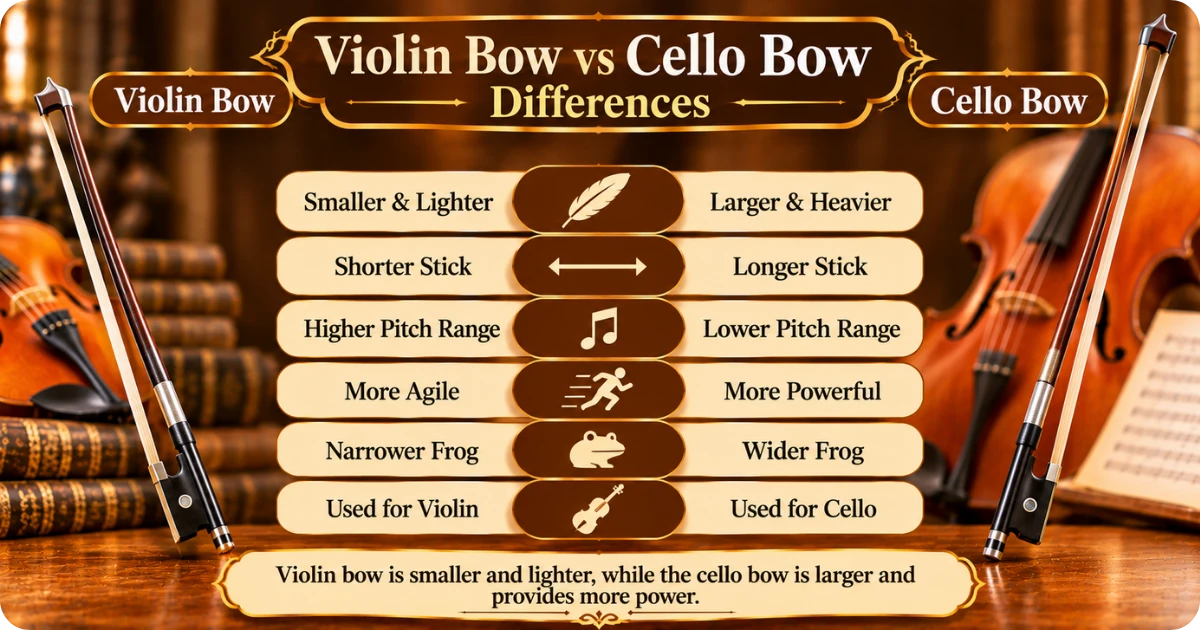
The violin bow vs cello bow question has a short answer. A violin bow is longer, at about 74–75 cm (29 inches), and lighter, at 55–65 g. A cello bow is about 72–73 cm (28.5 inches) and heavier, at 75–85 g.
They look almost the same, but they are built for different jobs. This guide explains the difference between a violin bow and a cello bow in plain words.
Violin Bow vs Cello Bow Size
violin-bow-vs-cello-bow-size
The violin bow is longer than the cello bow. The cello bow is shorter but heavier. Here is a quick comparison for a full-size (4/4) bow.
Feature
Violin Bow
Cello Bow
Length
74–75 cm (about 29 in)
72–73 cm (about 28.5 in)
Weight
55–65 g (about 60 g)
75–85 g (about 80 g)
Balance point
230–260 mm from the button
200–240 mm from the button
Hair ribbon
Narrower
Wider
Frog
Smaller
Larger and sturdier
Violin Bow vs Cello Bow Length
The standard bow length was set by the French bow maker François Tourte in the late 1700s. He chose 74–75 cm for violin and 72–73 cm for cello. Makers still follow these numbers today.
The difference is only about 2 cm. You can spot it when you place the two bows side by side.
Violin Bow vs Cello Bow Weight and Balance
Bow weight matters more than length. A cello bow is about 20 g heavier than a violin bow. That sounds small, but it feels big in the hand.
The balance point is the spot where the bow sits level on your finger. On a violin bow, it is about 230–260 mm from the button. On a cello bow, it is about 200–240 mm.
A viola bow sits in the middle, at 65–75 g.
Why Is a Cello Bow Shorter but Heavier?
The answer comes from the instrument. A cello is played upright, between the knees. Its string length is about 69 cm, while a violin string is about 32.5 cm.
Cello strings are thicker and heavier. They need more arm weight to start a clear tone. A heavy bow gives that weight with less effort.
The bow is also shorter because a cellist bows at the side, with the arm out in front. A shorter stick gives better bow control and less strain.
Violin and Cello Bow Sizes by Age
Kids use fractional bows. Violin bows run from 1/32 to 4/4. Cello bows run from 1/16 to 4/4. Most players move to a full-size violin bow around age 12. Most move to a full-size cello bow around age 13.
To find the right size, measure the arm. Stretch it out to the side. Measure from the neck to the middle of the palm. A full-size violin bow fits an arm of at least 23 inches. A full-size cello bow fits at least 24 inches.
A bow that is too long is hard to control. A bow that is too short limits your sound.
Bow hair is horsehair. Each strand is about 0.4 mm thick. A violin bow often holds about 150–180 hairs. A cello bow holds a little more. The hair ribbon on a cello bow is wider. It grips thick strings better. A violin bow has a narrower ribbon for fast, light notes.
Some cellists like black horsehair because it feels grabby. Many violinists prefer white horsehair for a smooth tone. The color is a matter of taste.
Frog, Stick, and Materials
The frog is the part you hold. A cello frog is larger and more rounded. It gives leverage for heavy strokes. A violin frog is slimmer.
The stick is made from pernambuco, brazilwood, or carbon fiber. Both bows can use any of the three.
Pernambuco is a dense Brazilian wood. It is the top choice for fine bows.
Brazilwood is a lower-cost wood for beginners.
Carbon fiber is strong and handles humidity well.
Bow Hold, Pressure, and Sound
The bow hold is not the same. Violinists keep the fingers at about a 30–45 degree angle to the stick. The little finger rests on top. Cellists keep the fingers more upright on the stick. The hand rests over the bow so the arm weight can flow into the string.
Bow pressure also differs. A violin uses light pressure and fast strokes. The sound is bright. A cello uses heavier pressure and slower strokes. The sound is deep and full.
A violin bow on a cello gives a thin, weak tone. It struggles to move the thick strings. It rarely gets past a soft volume.
A cello bow on a violin feels heavy and clumsy. Fast passages become hard. Control drops.
Think of flipping burgers with a fork. It might work, but a spatula does the job better.
Can the Wrong Bow Damage the Instrument?
Yes, it can harm the bow first. If you press hard with a light violin bow, the stick can warp. A warped bow loses its camber, which is the gentle curve in the stick.
A heavy cello bow on a violin can also cause scratches. It can hurt your technique too. Always use the bow made for your instrument.
A common guide is the one-quarter rule. Spend about 25% of the instrument price on the bow. For a cello, spend a little less.
For example, a $400 violin pairs well with a $100 bow. Players often spend less on the instrument to afford a better bow. The bow shapes how the sound is made.
Best Bow Material for Beginners vs Advanced Players
Beginners do well with brazilwood or carbon fiber. Both are tough and cost less. Carbon fiber also handles travel and weather changes.
Advanced players often choose pernambuco for its smooth, rich response. Many keep a carbon fiber bow as a second bow for travel.
Quick Bow Care Tips
Good care keeps a bow in shape. Follow these steps.
Loosen the hair after every session.
Do not touch the hair. Skin oil blocks rosin.
Tighten only until a pencil fits between the hair and the stick.
No. A violin bow is longer and lighter. A cello bow is shorter, heavier, and has wider hair. They are made for different strings.
Is a violin bow longer than a cello bow?
Yes. A full-size violin bow is about 74–75 cm. A full-size cello bow is about 72–73 cm.
Why is a cello bow heavier than a violin bow?
Cello strings are thick and heavy. They need more weight to make a full tone. A cello bow weighs about 75–85 g, while a violin bow weighs about 55–65 g.
How much does a violin bow weigh compared to a cello bow?
A violin bow weighs about 60 g on average. A cello bow weighs about 80 g. That is a gap of about 20 g.
Can I use a violin bow on a cello?
You can, but it is not advised. The tone will be weak. The light stick can also warp under pressure.
How often should I rehair a violin or cello bow?
Rehair every 6–12 months if you play often. Do it sooner if the hair looks worn or slips on the string.
Claire Davis is a content researcher and writer specializing in musical instruments, sizes, measurements, and comparison guides. She creates clear, practical content to help readers understand violin and other instrument sizes with confidence.